Compiled and written by Bass Player and Music Educator George Urbaszek
Remember the sopranos joke from the last newsletter? Well, subscriber Mal Zego from Australia has provided a bass version: “How many bass players does it take to change a light bulb? None, because bass players are never in the spotlight anyway!” Thanks Mal.
Speaking of spotlight, former student, Greg Royal, has been appearing on Australian Idol recently. He has been playing double bass on the big band numbers and bass guitar on some of the rock numbers. Good on ya Greg! Versatility certainly pays off.
I would like to welcome new subscribers to the Creative Bass Newsletter. This, as well as Weekly Bass Lessons, are now being enjoyed by subscribers from Mexico, Ecuador, the United Arab Emirates, Great Britain, Australia, Austria, the USA, Norway, Finland, the Philippines, India, Switzerland, New Zealand, Brazil, various African nations and more countries. Thanks for your support. I really like to pass on my experiences and see and hear them well utilised.
A new feature of Weekly Bass Lessons is the introduction of a monthly subscription fee. If this is more convenient for you, check out the section and click the link at the end of this newsletter to enable PayPal to guide you through the subscription process.
Here is today’s bass lesson
STRING CROSSING
We are often required to jump quickly to a neighbouring string within the same fret. On a bass with standard tuning this jump is the interval of a “perfect fourth”.
There are essentially three ways of string crossing within the same fret, each technique having its own merits and applications.
1. Jumping with the same fretting-hand finger
This is probably the most common technique for most applications. With good
fretting-hand technique, such as arched fingers and the thumb in the “correct”
position at the back of the neck, the “same-finger jump” is easy
and non-fatiguing. The jump can be executed quite fast, with only minimal note
clipping. It is great for County Music root-five lines and enables a “ghost-note
bounce”, creating an excellent feel.
2. Barring
If you want notes to ring into each other, barring the same finger across two
or more strings is a possibility. Often a neighbouring finger has to help push
down the barring finger. One advantage of this technique is that you can bar
two or more notes with the first (index) finger while playing higher-pitched
notes with the other fingers, creating a drone-like effect with a melody on
top.
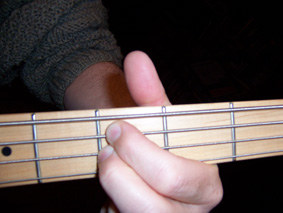
3. Cross Fingering
This technique takes the fretting hand out of its normal position. The wrist
moves to the left (for right-handed players) and the thumb wraps around the
neck. Two neighbouring fingers (either one/two or two/three) fret two neighbouring
strings. One major advantage of this technique is that we have complete control
of our note lengths, and therefore our grooves. Another advantage is that we
can usually synchronise left-hand/right-hand fingers, meaning that the same
finger that strikes the string also frets it. This technique is great for Soul
and Motown grooves where fourths jumps are common and very fast.
Here is a photo of the cross finger technique
I recommend you spend some serious fun time with all the listed string-crossing techniques to find what works best in which situations. Try the same groove using all three techniques to make a sound decision.
I trust you found this mini lesson useful. If you are not already a subscriber to Weekly Bass Lessons and would like to enjoy the benefits of affordable and systematic online lessons, then click the link below to subscribe. The weekly lessons are comprehensive and contain photos, audio and TAB.
You may know someone for whom online bass lessons might be just right. How about a long-lasting Christmas present? Click this link Creative Bass Lessons to view the new format web page and user-friendly fee structure.
All in Bass!
George Urbaszek
Bass lessons are supplied by Creative Bass
A division of Creative Avenues, ABN 22 323 614
466
Physical Address: 2 Nimbin Street
The Channon, NSW 2480, Australia
Phone/Fax: 061 266886143