Compiled and written by Bass Player and Music Educator
George Urbaszek
CreativeBass and CreativeBassLessons
A special welcome to the new subscribers to this eMag and to Creative Bass Lessons Online!
This edition of the Creative Bass eMag contains links to websites with useful and quality content to further your bass playing and musical development, especially in relation to aural skills.
I often spend hours checking out websites; sometimes I’m lucky, sometimes
I’m not.
If you come across links you think may be useful to your colleagues, please
pass them on for inclusion in future eMags. Although a couple of online drum
machines have been suggested, I have yet to find one that has good sounds and
is versatile.
What did you think of the “Guilty of Good Practice” story in the last edition of this eMag? Can you relate to either side? To make this eMag more interactive, please email (lessons@creativebass.com) your bass-related experiences so we can share and learn from them.
Today’s joke
(For me it used to be a reality, but I have overcome the limitations through
diligent practice.) I heard a version of this joke many years ago when working
with guitarist Don Andrews who used to play in the ABC Australia Radio and Television
band.
This joke is copied from a free-for-all website.
The annoying drums
This guy goes on vacation to a tropical island. As soon as he gets off the plane,
he hears drums. He thinks "Wow, this is cool." He goes to the beach,
he hears the drums, he eats lunch, he hears drums, he goes to a luau, he hears
drums. He tries to go to sleep, yet he hears drums.
This goes on for several nights, and gets to the point where the guy can't sleep at night because of the drums. Finally, he goes down to the front desk.
When he gets there, he asks the manager, "Hey! What's with these drums. Don't they ever stop? I can't get any sleep."
The manager says, "No! Drums must never stop. It's very bad if drums stop."
"Why?"
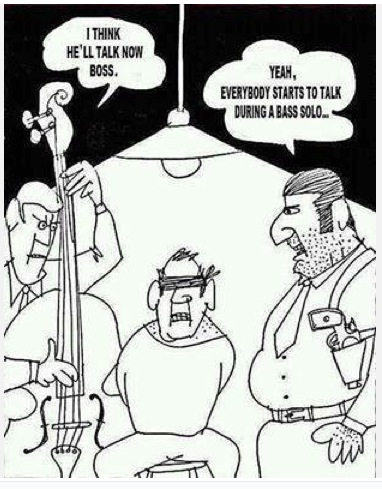
"When drums stop...bass solo begins."
.... and here is a follow-on cartoon submitted by student Phil Bradshaw from Australia
Upcoming gigs (after my trip up North) will be at my local tavern. This promises to be a very comfortable, not-far-from-home residency. The residency is comprised of two separate gigs: One is regular Friday night jazz and the other is being in the house band for an open mike Sunday afternoon. I love residencies because they enable development of style and repertoire; and I love the challenge of the “always-being-on-your-toes” of the open mike situation.
Links
As mentioned above, I have not yet found a decent online drum machine, but I
have found a site with a multitude of excellent drum grooves by many of the
world’s best drummers. You can listen to (via audio streaming) or download
MP3s of entire songs at Drummerworld
These tracks have the drums up in the mix. And you will certainly find some challenges in working out some of the bass grooves (more on that later). Of course it is fun to just play along with superb drummers!
RECOMMENDATION: Check if you have the stamina to play along non-stop with an entire track. See yourself as being part of the band, not just a “voyeur”.
Now here is a site that most bass players are familiar with: http://www.activebass.com Of course it is ActiveBass **. But have you really checked out the resources? These next two recommended pages will help you prepare for today’s lesson. On the home page of ActiveBass look up “Hot Tools” in the menu on the right. Click on “The Ear Training Machine” and on “Name That Note” to check your aural skills. If you can get five out of five questions right on each page, you are doing fine.
** Please Note: Active Bass is no longer active :(
Let me know if you find an alternative. In the meantime, I'll keep searching.
Today’s Lesson
Transcription Techniques – Part One
To transcribe literally means to write down. In music we use the term more loosely to describe the working out or “lifting” parts off recordings.
IMPORTANT ADVICE: If you are having trouble working out individual notes, make sure you stop the recording exactly on the note you are attempting to find. Immediately hum that note. Then look for it on your instrument.
If you are new to transcribing, or lacking in experience, play each neighboring fret until you find the note you are after (and preferably still humming). That way you are making sure you do not miss the note. (This simple step works wonders for beginners.) Most novices will jump all around the instrument, and usually end up never hitting the right note, often landing just next to it.
It does not matter a lot if you go up or down the fingerboard, because you will eventually find the note when playing every fret. Once you have found the correct note you can easily transfer it to the correct octave.
Be patient. Finding individual notes is usually easier and ultimately quicker than trying to work out entire passages - unless you are advanced.
This is also important for beginners: Ensure you remember the correct fret. Use the position markers on the fingerboard as a visual aid.
At first, don’t get caught up in intricacies such as ghost notes, hammer-ons, and other articulations. Go for target notes. You can fine-tune your transcription once you have the skeleton of the line.
It is advisable, even for advanced players, to re-visit the rudiments of transcription. Next eMag will have the continuation of this lesson. Use the resources suggested; they are all related to aural skills. To hear well makes us play well.
Bass of Luck!
George Urbaszek
Bass Player and Music Educator
Serving Bass Players Worldwide since 1996

PS
To purchase a CD to help with your aural skills, click HERE
* Please note that personal info in this and other eMags may be outdated. This is due to the fact that I decided to keep many of the eMag editions running due to their valuable and timeless lesson content.